Kimchi Explained: 9 Types, What They Taste Like and How Koreans Actually Eat It

Baechu-kimchi (배추김치), the napa cabbage kimchi most visitors picture first. Photo: Charles Haynes, Wikimedia Commons, CC BY-SA 2.0
The first time many visitors meet kimchi in Korea, it arrives without being ordered. You sit down for a bowl of noodles or a plate of grilled pork, and a small dish of red-seasoned napa cabbage kimchi lands on the table next to the chopsticks. Nobody explains it. A few minutes later, when the bowl is empty, someone may bring more without asking. That little dish is the easiest way to understand how Koreans think about kimchi: it isn't a special dish you order once on a trip. It's part of the table.
So what is it, exactly? Kimchi (김치) is a broad family of Korean vegetable dishes that are salted and then seasoned, usually with garlic, ginger, green onion and often red pepper flakes. Most types are fermented, though fresh kimchi is eaten before it ferments. Napa cabbage is the famous one, but radish, cucumber, green onion and mustard leaves all become kimchi too. Families, regions and seasons each have their own versions, which is why Koreans can talk about kimchi for a long time without getting bored.
Fresh, ripe and aged: why kimchi tastes different
Here's the part that surprises most people: kimchi doesn't have one taste. Koreans use different words depending on how fresh or aged it is.
Geotjeori (겉절이) is fresh, unfermented kimchi, eaten soon after it's made. It tastes like a crisp, garlicky salad: the cabbage still snaps and the seasoning sits on the surface. Regular kimchi, on the other hand, keeps changing as it ferments. Over days and weeks it becomes tangier and softer, a little fizzy on the tongue and deeper in flavor, and warmer storage speeds that up. Koreans often call this stage "well-ripened" kimchi (잘 익은 김치).
Mugeunji (묵은지) is kimchi deliberately aged at a low temperature for a long time, often six months or more. It is very sour and soft, and it is especially prized for stews and braised dishes because it gives them a rich, sharp backbone.
So if kimchi at the same restaurant tastes a little different from one visit to the next, nothing went wrong. Kimchi is a living food, and its flavor keeps moving.
9 common types you may meet in Korea
There are many regional and household varieties of kimchi. You don't need to learn them all. These nine are among the ones visitors are most likely to come across at restaurants, on home tables and in supermarkets.
1. Baechu-kimchi (배추김치): napa cabbage kimchi
The default. Whole or halved cabbages are salted, rinsed, and spread leaf by leaf with a red seasoning paste. It's spicy, salty, garlicky and, once ripened, tangy. When a menu just says "kimchi," it usually means this one.
2. Kkakdugi (깍두기): cubed radish kimchi
Korean radish cut into bite-size cubes and coated in red pepper seasoning. It's crunchy and juicy, often slightly sweet, and less leafy than cabbage kimchi. It is the classic partner for soups like seolleongtang (설렁탕, ox bone soup) and for gukbap (국밥, rice in soup).

Kkakdugi (깍두기), cubed radish kimchi, served as a side dish. Photo: comicpie, Wikimedia Commons, CC BY 2.0
3. Chonggak-kimchi (총각김치): ponytail radish kimchi
Made from whole young radishes with their green tops still attached. The radishes stay crunchy while the greens soften as the kimchi ferments.
4. Oi-sobagi (오이소박이): stuffed cucumber kimchi
Cucumbers slit and filled with a seasoning of chives, garlic and red pepper. It's fresh, juicy and best eaten fairly young, before the cucumber goes soft. You'll see it more often in warmer months.
5. Pa-kimchi (파김치): green onion kimchi
Long green onions seasoned whole. It has a pungent onion flavor when fresh and becomes tangier and more mellow as it ferments. If you like strong flavors, it's worth a try.
6. Gat-kimchi (갓김치): mustard leaf kimchi
Made with mustard greens and strongly associated with Yeosu in South Jeolla Province. It has a peppery, slightly bitter bite, a bit like arugula turned up a notch.
7. Baek-kimchi (백김치): white kimchi
Cabbage kimchi made without red pepper flakes, so it's pale and mild. Its generally mild flavor makes it a good option for diners who avoid spicy food.
8. Dongchimi (동치미): radish water kimchi
Radish kimchi served in a cool, lightly salty brine, traditionally made for winter. It's usually made without red pepper flakes, so it is mild and refreshing. You drink the liquid as well as eating the radish, and the brine is also used in some cold noodle dishes.
9. Nabak-kimchi (나박김치): sliced radish and cabbage water kimchi
Thinly sliced radish and cabbage in a pinkish brine. It often contains some red pepper, which gives the color, but it is still relatively mild. Like dongchimi, it's served with its liquid.
Gimjang: making and sharing winter kimchi

Gimjang (김장), making winter kimchi together, photographed on 1 December 2012. Photo: USAG-Humphreys, Wikimedia Commons, CC BY 2.0
If you visit Korea in late autumn or early winter, you may see piles of cabbages outside markets and apartment buildings, or hear coworkers say they're going home for the weekend to help with gimjang (김장, also spelled kimjang). This is the tradition of making a large batch of kimchi to last through the winter.
It is a team job. Someone salts the cabbages the day before. Someone else makes the seasoning, often with radish strips, garlic, ginger, fish sauce or salted shrimp, and sometimes fresh oysters, which are in season at the same time of year (we wrote about that in our guide to oyster season in Korea). Then everyone sits around a table in rubber gloves, spreading the paste between the leaves, chatting, and packing the finished cabbages into containers. Families and neighbors often share the results, and a bite of fresh kimchi wrapped around boiled pork (suyuk, 수육) is a traditional reward for the day's work.
UNESCO recognized this custom in 2013, adding "Kimjang, making and sharing kimchi in the Republic of Korea" to its Representative List of the Intangible Cultural Heritage of Humanity. The listing recognizes the communal practice of making and sharing kimchi and its role in bringing families and neighbors together; it isn't about one single recipe. Korea has also designated November 22 as Kimchi Day.
Many Korean homes have a separate kimchi refrigerator (김치냉장고) designed to keep fermentation slow and steady. If you stay in a Korean apartment and find a second fridge-like box with oddly specific settings, that is probably what it is.
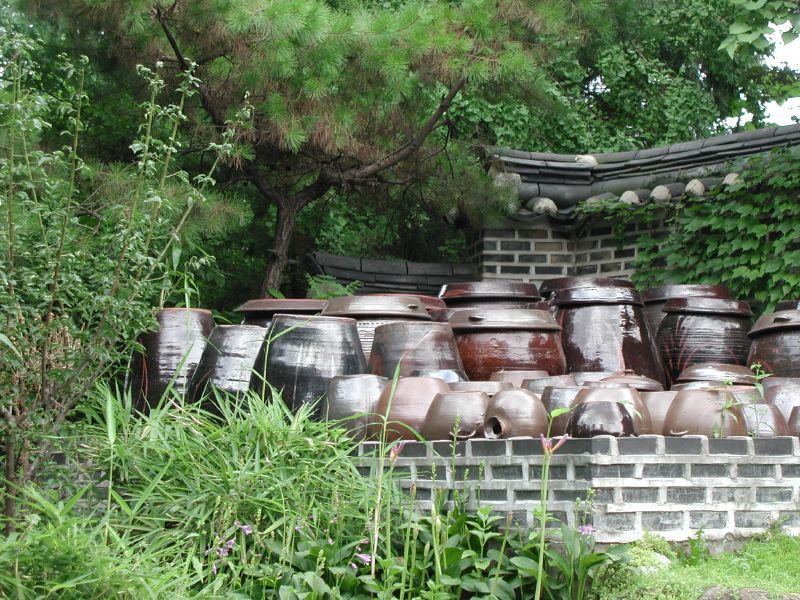
Onggi (옹기) earthenware jars at a hanok, the kind traditionally used to store kimchi, sauces and pastes. Photo: Drab Makyo, Wikimedia Commons, CC BY 2.0
Before fridges, kimchi and fermented sauces were kept in onggi (옹기), breathable earthenware jars. You'll still see rows of them on platforms called jangdokdae (장독대) at traditional houses and folk villages. Some families once buried kimchi jars in the ground for the winter, which kept the temperature cool and stable.
How Koreans actually eat kimchi
Visitors sometimes treat kimchi like a condiment to be tried once. In daily life, it shows up in at least three different ways.
- As a side dish (banchan, 반찬): a small plate next to rice, soup and whatever else is on the table. At many Korean restaurants, refills of basic side dishes are free, but some places now charge or use a self-serve bar, so check the sign or ask.
- As a partner for a specific food: kkakdugi with soup, fresh kimchi with boiled pork, and cabbage kimchi grilled on the edge of the pan at many barbecue restaurants.
- As an ingredient: sour, well-ripened kimchi is the base of kimchi-jjigae (김치찌개, kimchi stew), kimchi-bokkeumbap (김치볶음밥, kimchi fried rice) and kimchi-jeon (김치전, kimchi pancake). This is where older kimchi really shines, because cooking turns its sourness into depth.
A small table tip: side dishes, including kimchi, are traditionally shared, and people often eat directly from the communal dishes. Follow the table's lead, and use serving utensils when they're provided.
Common questions from first-timers
Is all kimchi spicy? No. Baek-kimchi and dongchimi are usually made without red pepper flakes (gochugaru, 고춧가루) and are generally mild, and nabak-kimchi often contains some red pepper but is still relatively mild. Even red kimchi varies a lot. Fresh kimchi often feels hotter than well-ripened kimchi, which turns more sour than spicy.
Is kimchi vegetarian? Often not. Many recipes use fish sauce, salted shrimp or other seafood. Vegan kimchi exists, and Korean temple kimchi is made without fish sauce or other animal products and without the five pungent vegetables, which include garlic and green onions. Elsewhere, you need to ask. "Haesanmuri deureogayo? (해산물이 들어가요?)" means "Does it contain seafood?"
Can I take kimchi home on a plane? Rules depend on your airline, on airport security and on your destination country's food import rules, and they change. Many shops sell kimchi in sealed, leak-proof packs for travelers. Check with your airline and your country's customs website before you buy a big tub.
Where can I learn more in Seoul? Museum Kimchikan (뮤지엄김치간) in Insa-dong, run by the food company Pulmuone, has exhibits on kimchi history and types, and it has offered kimchi-making classes. Opening days, fees and class schedules change, so check its official website before you go. In autumn, some regions also hold kimchi festivals, and cooking schools in Seoul run kimchi classes for visitors.
Checked in November 2026. Restaurant refill rules, museum hours and travel rules for carrying food change, so confirm on the official site or with the shop before you rely on them.
VISITKOREA, the Korea Tourism Organization's official channel, made the short video below about a kimchi-making trip to Goesan, a county in North Chungcheong Province, in the fall gimjang season.


Comments
Post a Comment